#Product Trends
Petstep: PET foam sandwich panel
Solution for lightweight stone and marine applications
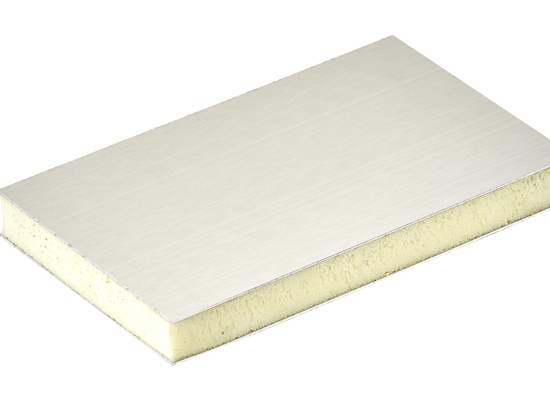
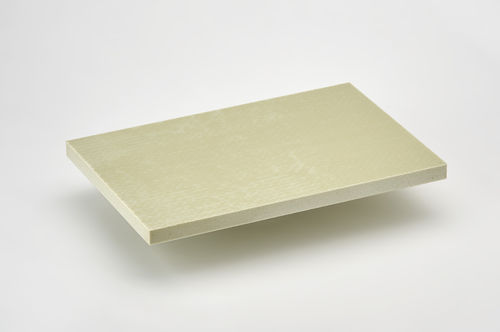
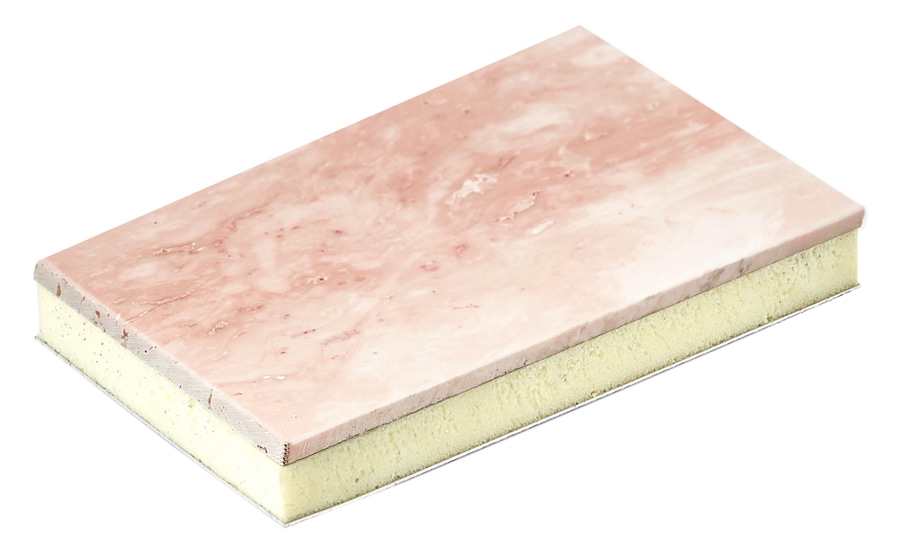
Petstep is a sandwich panel with a PET foam core and fiberglass skins impregnated with epoxy resin, developed for applications where lightweight construction, rigidity and mechanical robustness must coexist within the same system.
The panel is primarily used for lightweight stone, marine interiors, technical cladding and applications where good mechanical performance is required while reducing the overall weight of the finished component.
Compared to extremely lightweight sandwich panels, Petstep stands out for the more stable behaviour of its core structure and, in higher-density configurations, for the possibility of directly integrating mechanical fasteners without necessarily requiring inserts.
Panel structure and mechanical behaviour
Petstep consists of a PET foam core combined with fiberglass skins impregnated with epoxy resin.
This combination provides a lightweight panel with good flexural rigidity and higher resistance to concentrated loads compared to many traditional lightweight solutions.
One of the most important aspects lies in the nature of the PET foam itself.
Unlike honeycomb cores, PET foam is a continuous and homogeneous material. This means that the panel does not contain large structural voids inside the core, but rather a solid structure capable of distributing stresses more evenly.
From a mechanical perspective, the homogeneous structure provides improved distribution of concentrated loads, greater local stability and reduced risk of local crushing. During machining operations such as cutting, milling and shaping, the panel also maintains a more stable and predictable behaviour compared to honeycomb panels, thanks to the absence of structural voids and internal discontinuities typical of honeycomb cores.
Petstep configurations: density, weight and panel performance
Petstep can be configured with different PET foam densities and panel thicknesses, depending on the performance requirements of the final application.
In the lightweight stone and marine interiors sectors, the most commonly used configurations are those with PET densities of 100 kg/m³ and 200 kg/m³, offering different balances between weight reduction, local strength and fastening integration.
At the same thickness, core density directly affects both panel weight and mechanical behaviour. For example, a 10 mm Petstep panel with 100 kg/m³ PET weighs approximately 3.1 kg/m², while a configuration with 200 kg/m³ PET reaches approximately 4.0 kg/m².
Lower-density configurations are designed to maximise weight reduction, while higher-density versions provide improved resistance to concentrated loads, greater machining stability and more effective integration of mechanical fasteners.
For this reason, high-density configurations are particularly suitable for technical and marine applications where assembly, machinability and fastening systems are key design considerations.
Weight and mechanical behaviour: the technical balance
When discussing lightweight sandwich panels, weight is often the first parameter considered.
From this perspective, aluminium honeycomb panels remain one of the lightest available solutions. At equal thickness, STEP series panels with aluminium honeycomb cores can weigh between approximately 1.9 and 3.1 kg/m².
Looking purely at weight reduction, honeycomb panels therefore represent the most efficient solution.
However, real-world applications involve additional considerations such as local strength, fastening integration, machinability and installation simplicity.
Petstep was developed precisely as a balance between these factors. The panel is not necessarily intended to achieve the absolute minimum weight, but rather to provide a more manageable combination of lightweight construction, rigidity and mechanical behaviour during machining and installation.
High-density Petstep: high screw retention and fastening integration
One of the most interesting features of high-density Petstep is its high screw retention capability and the possibility of integrating mechanical fastners more easily.
In high-density configurations, starting from approximately 200 kg/m³, the panel can be directly fastened using conventional screws, without necessarily requiring inserts or local reinforcements in many applications.
This behaviour derives from the continuous and homogeneous structure of the PET foam. When a screw is inserted into the panel, the thread engages with material along the entire screwing path, ensuring a more uniform load distribution and good fastening stability, particularly in high-density configurations.
In honeycomb panels, by contrast, the cellular structure generally requires the use of inserts or dedicated anchoring systems, since the screw does not engage with continuous material inside the core.
The good screw retention capability therefore represents an important advantage, particularly in applications where seimplified installation, faster fastening integration and reduced secondary processing are required.
This does not mean that Petstep completely eliminates the need for inserts in highly loaded structural applications. Where higher mechanical loads or specific anchoring requirements are involved, dedicated fastening and anchoring systems are still used to ensure the required structural performance and reliability.
However, the possibility of directly using conventional mechanical screws significantly expands the panel’s application potential and helps simplifying machining, assembly and installation processes.
Stability during machining and milling
One of the most interesting aspects of Petstep is its behaviour during machining operations.
Cutting, milling, shaping and CNC machining are generally more stable and predictable, particularly in applications requiring complex geometries or fastening integration.
The continuous structure of the core contributes to a more uniform panel behaviour during machining, reducing the risk of local criticalities and improving material controllability.
From an operational perspective, this helps reduce additional processing, corrective interventions and installation complexity, improving the overall management of the production process.
Petstep for lightweight stone and marine interiors
In the marine sector, lightweight stone must simultaneously meet requirements related to weight, rigidity, machinability and reliability. In some applications, exposure to outdoor or humid environments also requires good resistance to moisture absorption. In these cases, Petstep represents a particularly suitable solution thanks to the closed-cell structure of the PET foam which, together with the intrinsic properties of the material itself, helps limit moisture absorption while maintaining dimensional stability and mechanical performance over time.
Yacht and mega yacht interiors often require shaped panels, custom machining operations and fastening integration within complex installation environments. In these applications, the final panel weight is not the only relevant factor; ease of handling throughout all project phases also becomes critical.
In this context, Petstep offers a particularly effective approach by combining lightweight construction, good local strength, improved machining stability and direct fastening integration capabilities.
The panel is therefore used not only to reduce stone weight, but also to improve the overall management of the system during production and installation.
To learn more about the use of sandwich panels in the marine industry, see the article “Lightweight marble for yachts and cruise ships: sandwich panels with honeycomb or foam core?”, focused on the comparison between honeycomb and foam core panels in marine applications.
For a broader overview of natural stone lightweighting technologies, refer to the article “Marble lightweighting: how sandwich panels make stone lighter”.
Petstep and fastening systems
A further development of the Petstep panel involves integration with dedicated technical fastening solutions.
This also includes the collaboration with Specialinsert®, focused on the development of fastening systems that can be integrated into lightweight panels.
The goal is to design panels already prepared for anchoring system integration, reducing additional processing operations and further simplifying installation and assembly.
In this way, the lightweight panel is no longer just a structural support, but becomes an integral part of the overall fastening system.