#Product Trends
Application Background of the Main Engine Electronic Control System
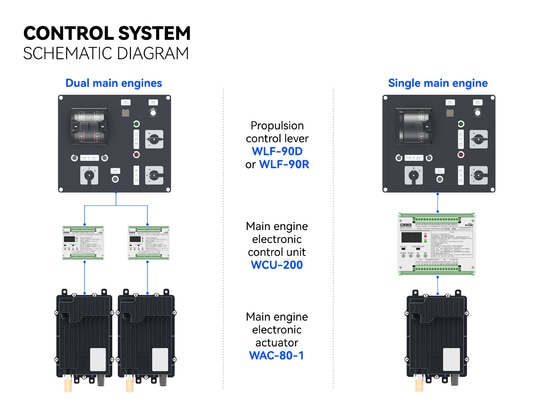
The application context of this type of product is that traditional mechanical/pneumatic execution methods are unable to meet the requirements of precision, remote control, compliance, and intelligence.
I.Limitations of Conventional Control Methods
Mechanical-hydraulic governors, pneumatic remote control, and flexible cable linkages suffer from lag, wear, air leakage, travel deviation, and high maintenance costs, especially in long-stroke low-speed engines, remote operation, and transient-response scenarios. They struggle to provide repeatable and precise throttle control over long distances.
II.Advantages of Electronic Actuation
Electronic governors combined with electric servo actuators offer faster response and higher dynamic accuracy. Functions such as starting ramp, fuel limit, and speed regulation can be configured through parameter settings, reducing dependence on manual experience and mechanical adjustment.
III.Regulatory Compliance Drivers
Under rules such as EEXI/EPL, electronically controlled engines can implement power limitation through software and facilitate audit verification. Mechanical control often relies on seals or mechanical stops, which are less convenient for compliance management. This promotes electronicization of the main engine throttle execution layer.
IV.Intelligent Integration Requirements
Remote/autonomous navigation and smart ships require main engine control to support bus access, position feedback, fault degradation, and redundancy management. Electric throttle actuators can serve as addressable and feedback-capable network nodes, supporting closed-loop control by upper-level systems.
V.Lifecycle and Supply Chain
Older governors and actuators face discontinuation, difficult spare parts availability, and rising maintenance costs. The engineering maturation of domestic electronic governors and electric actuator products provides more sustainable supply and lifecycle-cost options for medium- and low-power vessels and existing ship retrofits.