#Industry News
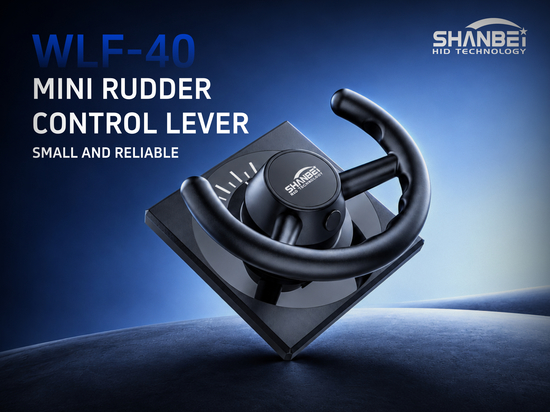
Trends in Marine Mini Rudder Control Lever Development
Focused on system-level coordination, reliability in harsh environments, and ultimate manoeuvring simplification.
I. System Integration and Coordinated Control
1)Evolving from a standalone control device to an integrated human-machine interface (HMI) within the integrated bridge system (IBS).
2)Translating operator commands into coordinated actions of propulsors, rudders, and thrusters via electronic/hydraulic systems, enabling precision station-keeping and low-speed manoeuvring.
--------------------------------
II. Manoeuvring Simplification and Safety Enhancement
1)Supporting functions such as heading hold, dynamic positioning (DP), and track control, substantially reducing pilot workload.
2)Enhancing operational safety and response time in confined waters or heavy weather conditions.
--------------------------------
III. Industrial-Grade Reliability and Precision Actuation
1)Critical actuation components (e.g., linear actuators) must meet industrial-grade parameters.
--------------------------------
IV. Intelligent and Autonomous Evolution
1)Fusing situational awareness data with ship hydrodynamic models to enable autonomous collision avoidance, optimal weather routing, and adaptive steering control.
2)Supporting shore-based remote monitoring and emergency override, becoming a key enabler for unmanned surface vessels (USVs) and autonomous shipping.
--------------------------------
V. Multi-Energy and New Energy Compatibility
1)Deeply integrated with electric or hybrid propulsion systems, improving overall energy efficiency and acoustic signature.
2)Future-ready for direct integration with next-generation clean energy systems such as hydrogen fuel cells.
--------------------------------
VI. Standardisation and Modular Design
1)Controllers are evolving toward standardised, modular architectures, with form factors diversifying from large integrated bridge consoles to portable handheld or wearable remote-control units.
--------------------------------
VII. Market Application and Growth
1)Market coverage includes luxury yachts, specialised workboats, patrol craft, and fishing vessels, with a compound annual growth rate (CAGR) generally projected at 3.6%–4.4% through 2035.
2)Demand driven by new energy vessels, autonomous navigation, and other emerging maritime requirements continues to propel market expansion.